Queer Places:
8 St Aubyns Mansions, King's Esplanade, Hove BN3 2WQ
Putney Vale Cemetery and Crematorium, Stag Ln, London SW15 3DZ, United Kingdom
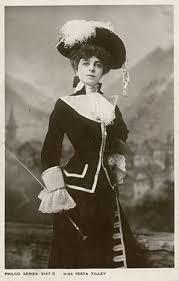 Vesta Tilley (May 13, 1864 – September 16, 1952) was born Matilda Alice Powles on May 13, 1864, at Beaver Row in Worcester. She grew up as the second of
thirteen children born to Matilda Powles (née Broughton) and William Henry Powles, a china painter, musician, and comic who later performed as Harry Ball
the Tramp Musician. Moving her family first to Gloucester in 1870—where her father managed the Star Music Hall and young Tilley made her stage debut before
age four—and then to Nottingham in 1872, her father took full control of managing her burgeoning performance career. Billed early on as "Tilley Ball" or
"Little Tilley," she made her professional debut in 1869 singing songs dressed as a boy, a choice she embraced because she felt she could express herself
much better in masculine attire.
Vesta Tilley (May 13, 1864 – September 16, 1952) was born Matilda Alice Powles on May 13, 1864, at Beaver Row in Worcester. She grew up as the second of
thirteen children born to Matilda Powles (née Broughton) and William Henry Powles, a china painter, musician, and comic who later performed as Harry Ball
the Tramp Musician. Moving her family first to Gloucester in 1870—where her father managed the Star Music Hall and young Tilley made her stage debut before
age four—and then to Nottingham in 1872, her father took full control of managing her burgeoning performance career. Billed early on as "Tilley Ball" or
"Little Tilley," she made her professional debut in 1869 singing songs dressed as a boy, a choice she embraced because she felt she could express herself
much better in masculine attire.
Her early signature performances included spoofing opera tenor Sims Reeves as the "Pocket Sims Reeves" by singing pieces like The Anchor's Weighed. By
1872, she was already supporting her entire family through her earnings. In 1874, she completed her first London season performing nightly across three
venues. Edward Villiers, manager of the Canterbury Music Hall, suggested a change to avoid gender ambiguity in her billing; consequently, her father chose
the stage name "Vesta Tilley" (combining "Vesta"—referencing the virgin goddess and Swan Vesta safety matches—with "Tilley," a diminutive of Matilda),
using it officially from April 1878 at the Royal Music Hall in Holborn.
Throughout the 1880s and 1890s, Tilley's star ascended as "the London Idol," renowned for her meticulous attention to detail, wearing tightly plaited
hair under authentic custom wigs and men's undergarments to achieve a realistic male silhouette. Known primarily for dandy and fop personas like
"Burlington Bertie," she also portrayed policemen, clergymen, and soldiers, alongside playing principal boy roles in pantomimes such as Robinson Crusoe,
Beauty and the Beast, Sinbad the Sailor, and her favorite, Dick Whittington. As a pioneer of family-friendly music hall entertainment, she captivated both
working-class men who delighted in her upper-class mockery and women who celebrated her independence. By the 1890s, she was England's highest-earning
woman, commanding top salaries, making some of England's earliest sound recordings in 1898, and undertaking six successful tours of the American vaudeville
circuit where she earned up to $600 per week.
Following the death of her father in 1888, Tilley married theatre impresario Walter de Frece in 1890, who subsequently became her manager and
songwriter. In 1912, during a Royal Command Performance, she famously scandalized Queen Mary by wearing trousers while singing The Piccadilly Johnny with
the Little Glass Eye. During the First World War, as her career began to wind down, she reinvented her platform to champion the war effort. Performing in
khaki fatigues to patriotic numbers written by her husband—such as The Army of Today's All Right, Six Days' Leave, and Your King and Country Want You—she
earned the moniker "England’s greatest recruiting sergeant," inspiring hundreds of men to enlist in what became known as "The Vesta Tilley Platoon," while
also occasionally introducing reflective numbers like I'm Glad I've Got a Bit of a Blighty One.
Following Walter's knighthood in the 1919 King's Birthday Honours for his war services, Tilley became Lady de Frece and chose to retire from the stage.
Her year-long farewell tour directed all proceeds to local children's hospitals, culminating in a legendary final performance on June 5, 1920, at the
Coliseum Theatre in London where she was showered with bouquets. Supporting her husband's political career as a Conservative Member of Parliament for
Ashton-under-Lyne and Blackpool from 1920 to 1931, she was formally presented at court as Lady de Frece in 1923.
In her later years Vesta Tilley returned to the Brighton and Hove area—where she had frequently performed earlier in her career at venues like the
Brighton Hippodrome and Theatre Royal—and lived in a seafront apartment at St Aubyns Mansions.
After Sir Walter's death in 1935, she retired to Monte Carlo. Tilley passed away at age 88 on September 16, 1952, during a visit to St James's in London, and was buried alongside her husband at
Putney Vale Cemetery. Her remarkable life was later commemorated in the 1957 biographical film After the Ball.
While Vesta Tilley maintained a conventional heterosexual marriage to Sir Walter de Frece, her professional mastery as a premier male impersonator
secures her legacy as a foundational figure in queer history and gender performance studies. By intentionally crossing sartorial boundaries, donning men's
tailoring, executing precise masculine mannerisms, and exploring the fluidity of gender presentation on the Victorian and Edwardian stage, Tilley
anticipated modern drag king artistry and gender subversion. Her ability to captivate predominantly female audiences by playfully deconstructing
masculinity offered early spaces for female homosocial bonding and challenged rigid Victorian binary norms, securing her enduring celebration within
LGBTQ+ cultural heritage.
References:
Other references:
- De Frece, Matilda Alice Powles (Lady de Frece). Recollections of Vesta Tilley. London: Hutchinson & Co., 1934. (Her primary firsthand account detailing her stage career, upbringing, and life in the music halls).
- Maitland, Sara. Vesta Tilley. London: Virago Press, 1986. (A key biographical re-evaluation published in the Virago Pioneer series).
- Sudworth, Gwyneth. The Great Little Tilley. 1984. (An earlier biographical work drawing heavily on her personal memoirs).
- Senelick, Laurence. The Changing Room: Sex, Drag and Theatre. London: Routledge, 2000. (Examines the broader theatrical and historical traditions of male impersonation, featuring extensive analysis of Tilley).
- Oxford Dictionary of National Biography (ODNB). "Tilley, Vesta [real name Matilda Alice Powles; married name Matilda Alice de Frece, Lady de Frece]" (Online edition).
- Encyclopædia Britannica. "Vesta Tilley | British music-hall artist".
- Worcestershire County Council / Worcestershire Archive and Archaeology Service. The Vesta Tilley Collection: The Music Hall Actress From Worcester (1864–1952). (Houses regional documents, photographs, and local memorabilia).
- National Fairground and Circus Archive (University of Sheffield). Research guides, programmes, and theater collections concerning Vesta Tilley.
- Victoria and Albert Museum (VAM) Theatre and Performance Collections. London. (Holds photos, costume ephemera, and posters from her career).
- National Portrait Gallery (NPG). London. (Maintains photographic portraits and prints of Vesta Tilley and Lady de Frece).
- New York Public Library Digital Collections. Vaudeville era prints and promotional materials from her US tours.
- UCSB Cylinder Audio Archive (University of California, Santa Barbara). Early sound recordings of Vesta Tilley from 1898 onward (such as "It's part of a policeman's duty" and "I'm the idol of the girls").
- After the Ball (1957 film). Directed by Compton Bennett, starring Pat Kirkwood; a biographical feature film dramatizing Tilley's life and stage career.
Support this project
This website is a passion project researched, developed, and funded entirely by me. If you find the content valuable and would like to help support the ongoing research and hosting costs, any contribution is deeply appreciated.
Thank you for keeping this independent resource alive!
My books on Amazon: Elisa Rolle's books
BACK TO HOME PAGE